At Think Heuristics, we have bucked the trend. Where the norm is to teach by topics, we teach according to problem-solving heuristic techniques. With these techniques at their fingertips, students can apply it confidently and successfully across various topics.
What is Maths Heuristics?
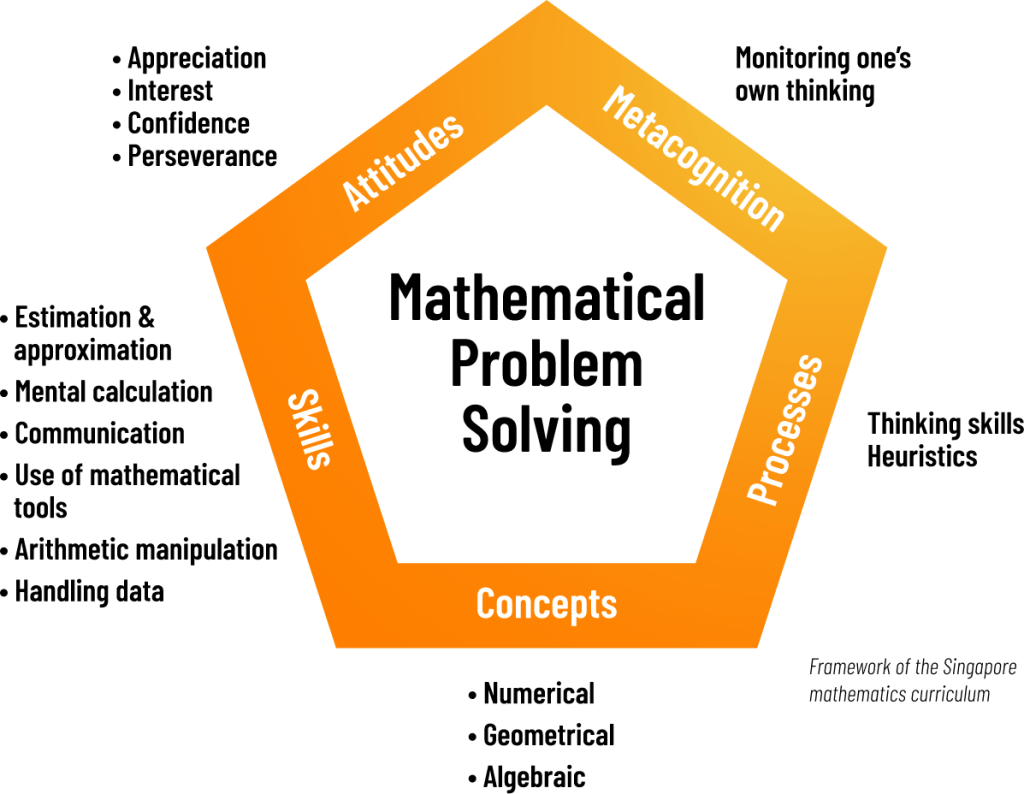
According to MOE, heuristics is essential for mathematical problem solving. Heuristics are general rules of thumb of what students can do to tackle problems – “from routine mathematical ones to problems in unfamiliar contexts and open-ended investigations that make use of the relevant mathematical heuristics and thinking processes.”
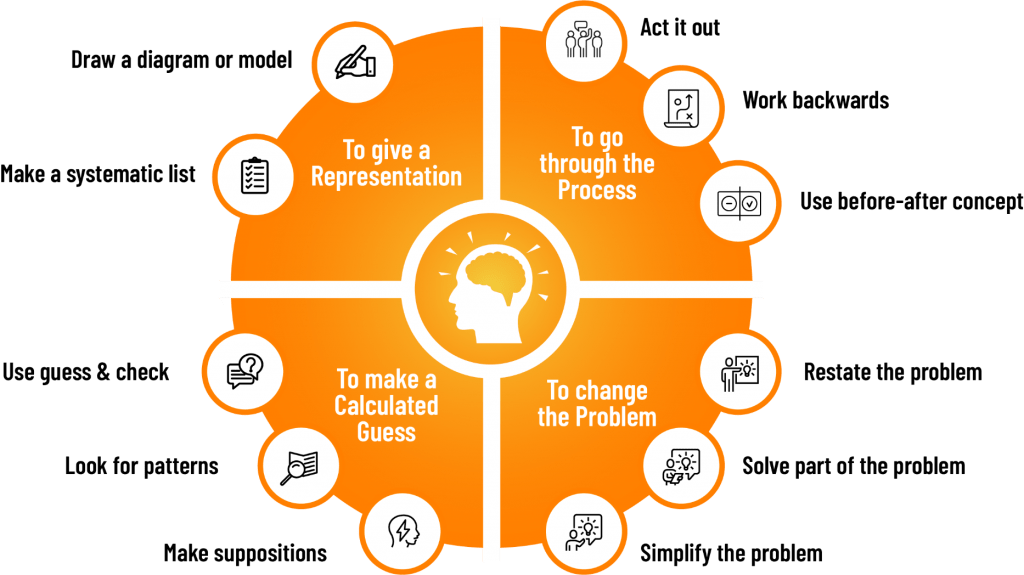
There are a total of 13 heuristics applicable to mathematical problem solving, two are for secondary school.
Below are 11 approaches taught to Primary 3, 4, 5 and 6 students which can be grouped into four categories.
At Think Heuristics, the 11 heuristics are structured into modules and delivered through weekly lessons & workshops.
Our Core Maths Modules for Students
Module 1: Unit Transfer Method
Heuristics covered:
Before & After, Restate the problem, solve part of the problem, simplify the problem
UTM apply across topics of Whole Number, fraction, decimal, ratio, percentage, rate, speed (P6 only)
Simple, logical and yet powerful Unit Transfer Method
Categories problems into six concepts – Before and After, Excess and Shortage, Repeated Identity, Equal, Two Variables and Proportion
Model 2: Model Approach to Problem-solving (MAPS) & Branching Method
Heuristics covered: Daw a Diagram or Model, Act it out, Restate the problem, solve part of the problem, simplify the problem
“see” mathematics through the drawing of models
students will learn to visualise, perceive and analyse & develop the ability to think in mental pictures.
Go beyond conventional models and solve challenging problems fast with highly-efficient techniques like Stack Model and Split Model.
Alternate approach to non-visual child struggle with model – Branching method – – – identify keywords to determine which approach to use will be effective
Module 3: Heuristics Approach to Problem-solving (HAPS)
Heuristics: Guess & Check, Supposition, Systematic Listing, Pattern and Working Backwards, spatial visualisation techniques
Spatial Visualisation: Pupils must mentally “see” and manipulate one or more shapes or objects without the aid of physical materials shape
Module 4: Higher-order Thinking Skills (HOTS)
Bring together the heuristics learnt from 1,2,3
This advanced module hones students’ problem-solving skills.
Consolidiate all the 11 heuristics, train child hwo and what heuristics to choose when face unfamiliar questions
will acquire high-level analysis, synthesis and evaluation skills
With an open mind, our students will begin to see the fruits of applying their scientific knowledge correctly, and reaping the results of higher level scores.